Archive

Archive for the ‘Gear Review’ Category

Highlights from the Open Air Demo – Outdoor Retailer Show 2011
Thursday, August 4th, 2011

This was our first year at the Open Air Demo part of the Outdoor Retailer Show.  It was held at Jordanelle Reservoir near Park City and it is more focused on water based sports.  Here are some of the neat things we saw.

Stand Up Paddleboards (SUP’s)

stand up paddle boards - outdoor retailer 2011 open air demo

These were the hit of the show and there were lots of them.  Seeing about a hundred people demoing SUP’s was more of a sight than all of the colorful tents and easy-ups.  Hardly anybody was demoing kayaks, guess we’re all over that.  The SUP’s came in three main categories.  Inflatable SUP’s are for travel, whitewater, and general use. There are other general use ones made of plastic and fiberglass. There are also racing SUP’s that are skinnier and made of fiberglass.  All of the general use ones were easy to use, but the racing one was quite tippy and difficult to turn.  I fell off of it twice and decided I should return it before I caused further embarrassment to myself.

SUP Shoes

SUP shoes by chaco

What would any sport be without it’s specialty gear.  Yes, you too can own your very own SUP shoes.  I didn’t try them because I have far too many shoes already. These shoes shown are made by Chaco.

Go Pro 3D Camera

Go Pro 3D Camera

Although I’m not a big fan of 3D movies in general as too often they end up more gimmick than guts.  This camera did however seem pretty neat, and the tech geek in me made me change course and go talk to the Go Pro guys.  I look forward to seeing some real sports action in 3D made with these. They also go 180 feet underwater which is pretty sweet too.   The ones with the two lens’ is the 3D one.

Whitewater River Board

White Water Boogie Board by NRS

These didn’t seem too popular as I only saw one of them at the show, but the idea of boogie boarding through class 4 or 5 whitewater seems pretty rad.  Maybe I’m crazy?  I’m jazzed though.  Sign me up for one of these.  This particular one is made by NRS.

Kayaks

Kayaks at OR Open Air Demo

Yup, these are kayaks. We’ve all seen them and we all know what they do.  Moving on…

Land Paddle

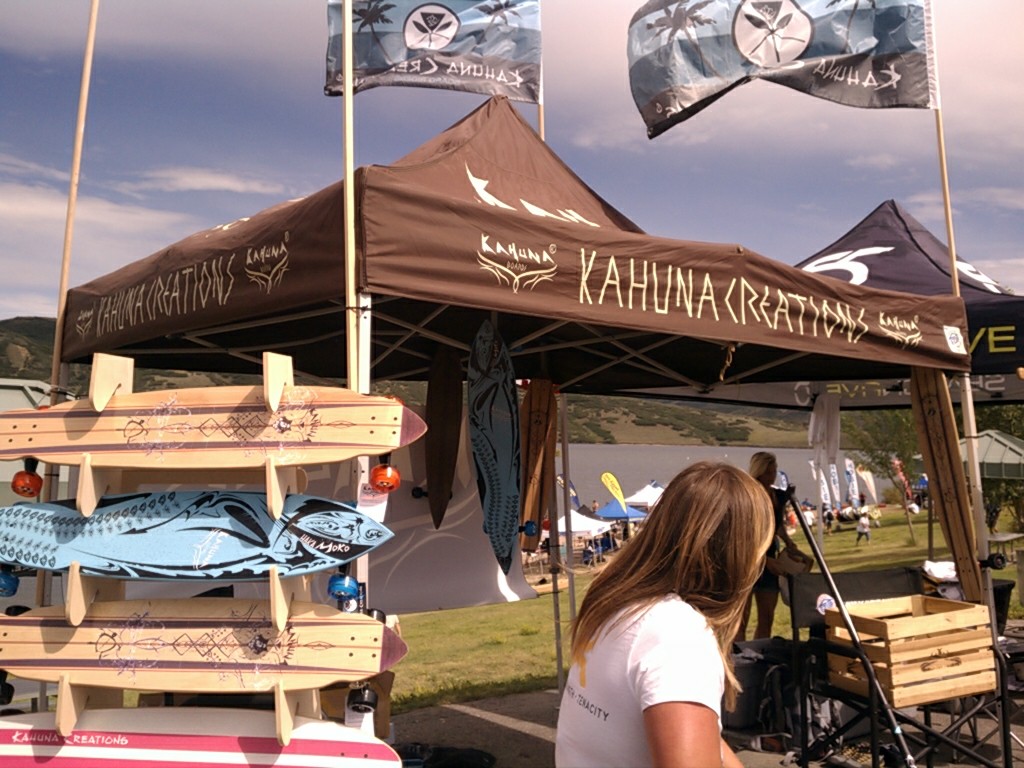
Kahuna Long Board Stick

Kicking for propulsion on a long board is old news.  Now you can push.  Kind of makes a long board into a land version of the Stand Up Paddleboard.  Wanna get your teenager out of the house? Buy them one of these!  It worked for us :-) This one was made by Kahuna Creations.

It’s Greek To Me!

Tuesday, May 3rd, 2011

kalymnos greeceTravel tips for Kalymnos

This last month, I was lucky enough to spend three weeks in Kalymnos, Greece. Kalymnos is an easy place to be with fantastic climbing, good food and wonderful people. There is almost no petty crime or theft, which is a nice change from some of the other climbing areas I’ve visited.  It is also still fairly affordable, if you cook and choose basic accommodations.   Each time I travel I get more savvy,  so I thought I would share what I have learned.

  • Pack sturdy approach shoes. Although most of the approaches are short I didn’t think they were trivial, and after a few days my legs, feet and hips were worked.  I brought light running shoes a but my Asolo approach shoes would have been a much better choice for the steep and loose terrain.  If you have knee problems,  I would bring hiking poles as well.
  • Bring a warm jacket.  I threw my Outdoor Research down sweater in at the last minute and was happy to have it.  My trip took place the last part of April through the first part of May and I wore it nearly every day, both at the crag and in the room.  The weather reminded me of the mountains as it changed frequently through out the day.
  • Use the public transportation.  We thought we would rent a scooter for a few days, but found the local bus to meet our needs for both getting to the crag and into Pothia. You can buy tickets from the local mini marts. I also hitch hiked quite a bit and felt very safe.
  • If you head to Pothia, remember they have siesta from 1:00-5:00 and many business’s  are closed.
  • Bring comfortable climbing shoes. Although you want performance from your climbing,  the routes are long and often times you are climbing in the sun.  I would opt for a comfortable pair of shoes over a super tight pair.  I absolutely loved my Evolv Talons.  The worked great over there and were super comfy.
  • Bring tape and chalk.  A role of tape was about $9 US dollars.  I would much rather spend that on a good meal and tape and chalk are light!
  • Bring 70 meter rope bi-color rope.   I brought the Sterling Nano bi color and loved it.  Because many of the routes wander, you can get off a 40 meter route with a 70 meter rope, but it’s nice to have the middle marked as many of the routes are 30 plus meters.
  • If your a coffee lover, bring your own! I was happy to have my stove top espresso maker and some good coffee, as it’s hard to find both over here.
  • Book a room for a few days before hand, then once you get there shop around to find a room that has the things you need such as internet, location close to the cliff, kitchenette. Most of the hotels/studios get a large percentage of their bookings on a walk- in basis.  Even on Easter, one of the busiest weeks of the year, there were a still few places with available rooms.  You are also in a better position to negotiate the price once you are there.
  • Bring a signal booster if you need internet.   Many places advertise Wi-fi, but most do not have it available in the rooms.  I stayed at Galouizes, which had Wi-fi in the rooms, but it wasn’t a great signal.  If you plan on working, this would be money well spent.

Things I loved in Greece are:food kalymnos greece
The cheese and yogurt, the greek combo plates, the oranges, the pastries and bread, the vegetable truck that came through town every few days, the people and of course….the climbing!

How to Make an Adjustable Stand Up Desk for About $50
Monday, April 25th, 2011

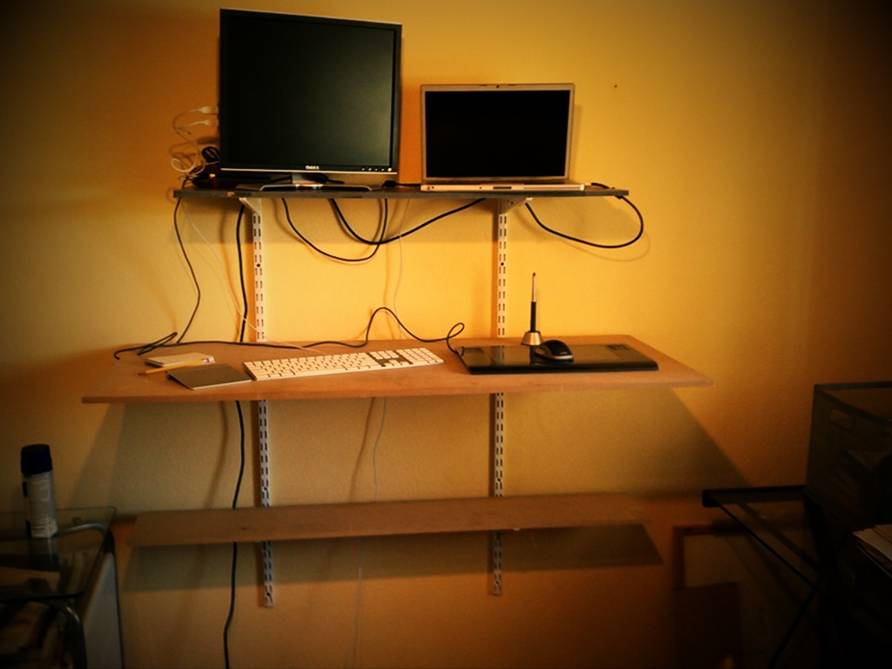
stand up dest for under fifty bucksI recently read about the benefits of working at a standup desk in a couple web articles.  It really intrigued me.  I had heard of someone doing that before and I dismissed it as strange, but I didn’t think much about it at the time.  The heath benefits the article claimed were pretty staggering.  If it was right on just  a few of these, I was interested.  Heck, think of all the money I could save on coffee if standing up all day really gave me more energy!  The article said sitting down all day caused problems like:

  • obesity
  • heart disease
  • poor posture
  • fatigue

I knew I wanted to better my posture and I’ve been trying various things over the years to help that.  I’ve tried working on a fit/yoga ball, various types of pointing devices and different desk setups.

Once I read the article about the stand up desk I was interested.  I went online and quickly realized you can spend a lot of money on a stand up desk.  I wasn’t sure I would like it, so of course I wanted one that could up and down or a non-permanent solution.  I tried to figure out how I could elevate my desk and keep it stable.  The desk only needed to be about 15″ higher. I saw pics online of people stacking things, but I have a rug in my office and I didn’t think it would be stable enough.

A trip to Home Depot and some wandering of the isles, brought me to a clever solution.  Here are some simple things you can get to make a home stand up desk that is adjustable.  This one is wall mounted, so you may need to re-organize you office some.

Go to your local hardware store and head into the isle for shelving.

What to Buy

  1. 2 each of Rubbermaid FastTrack 25 in. Upright Track Extension – $11
    Note: You can purchase these if different sizes, if for example you want a lower shelf.
  2. 2 each of Rubbermaid 11-1/2 in. Twin Track Bracket - $8.5
    These are for the top shelf to hold the monitors.
  3. 2 each Rubbermaid 18-1/2 in. White Twin Track Bracket – $13.50
    This is for you keyboard and mouse to go on.
  4. 1 each piece of wood 48″ x 22″ x 1/2″ – $9
    You can change the size based on what you want your desk like.
  5. 1 each piece of wood 48″ x 12″ x 1/2″  - $7
  6. Screws to mount the tracks to the wall – $4

Total: Aprx. $55

You could get it down to $50 if you used cull lumber for the upper shelf which goes for about $.51 if you can find the right size.

Tools You’ll Need

  1. Drill
  2. Screwdriver
  3. Studfinder (optional)
  4. Level (optional)

Set Up

You’ll screw the wall mounts to studs in the wall, making sure they are level.  The desk portion should be the height of your arms bent at 90 degrees.  Set the monitor shelf so that the monitors are at eye-level.

My Review

So far I love my stand up desk.  I moved around more which is great for my posture.  I also don’t have the inevitable neck sag that occurs whenever I sit down.  For casual computer experiences like watching YouTube, it’s not as ideal for, but if I’m in front of a computer I should be getting some work done.  I still get a little tired at the end of the day, but in general I feel more alert while I’m at the machine.  I also find this desk set up to be easier to adjust for ergonomics than a sit down desk.  I may add some cross supports to the desk shelf for stability, but aside from that, I love the set up and I think I”ll be using it for awhile.

Further Reading

Petzl Ergo Ice Tool Review

Monday, February 28th, 2011

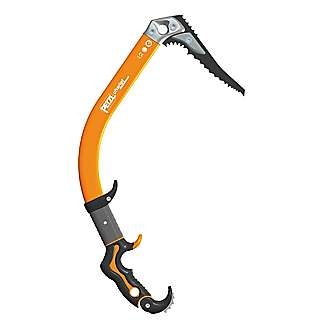
petzl ergoOK, first of all, I want to address the fact that is doesn’t have anything to do with web development. I hope that’s OK for some of you. We over here at Visual Adventures are not one trick ponies. We choose to excel at more than one thing. As mentioned in other blog posts, web designers like us are busy trying to save the world, and thus special skills are required.

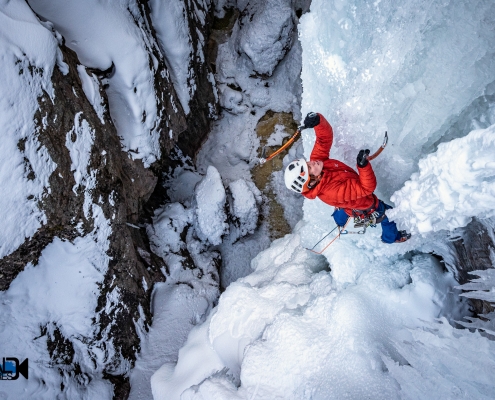
On Christmas eve the Ergo’s arrived at my doorstep in the snowy hamlet of Ouray, Colorado. It was like a gift from Santa Claus. The Petzl Ergo has three grip positions where other ice tools have only two. I was a little skeptical of the third position as it certainly changes the angle of pull when you get up on it. Since my hands are quite big, the adjustable third pinky rest sits high. As a result, there is not a lot of room for a gloved finger to not get squished.

I was instantly impressed by their aggressiveness on the rock. I felt like they’ll stick to almost any nubbin of rock. A couple days later found me near the top of my M12 project. My hands where a bit crossed up and I found myself on the third grip of the tool. The rock sailed through my vision and I came to rest on the rope. Dang! Redpoint averted! As suspected, you have to be careful when using the third grip. The next attempt I avoided using the third grip except in an inverted stein pull, and found myself clipping the chains on my new route.

A few days later, I found myself on Goldline, a well know M10 in Ouray. I breezed through the big rock roof and gained the hanging icicle at the top. It hadn’t been climbed yet this year so I was forced to swing my tools delicately into the thin pillar. It was quite awkward and I felt I had to work hard to get purchase. This was of course the first time using the Ergo’s on ice, so it was a bit rough of a first date.

The next date with the Ergo’s was in the Ouray Ice Park on opening day. I scooted over to a WI5 pillar named Popsicle in the lower bridge area. It had not been climbed yet and was in typical ice park shape, chandaliered. I found the

Pine Creek – a good beginner slot canyon in Zion

Friday, July 30th, 2010

Pine Creek Canyon of Zion is a great slot canyon for someone just learning about canyoneering.  It’s fairly short and non technical,  has minimal swimming and good anchors.  Zion Adventure Company set us up with wet suits for a minimal cost.  I wouldn’t say that a wet suit is required, but it will definitely make the whole experience more enjoyable.  You do, however,  need ropes and basic rope experience.

  1. First Rappel Pine Creek Canyon This is the first rappel into the canyon.   Right now my wife is thinking “If I have to swim through stagnant, dead animal invested water, he’s never going to hear the end of it.
  2. First bit of water in Pink Creek Canyon Let the cussing begin. There’s no turning back now.
  3. canyon light in Pine Creek Canyon Zion A narrow sliver of sunlight warms up the moment.
  4. Rapelling into the darkness, Pine Creek Canyon UT Hope you’re not afraid of the dark, and what might be in that dark water.
  5. Rapelling into arches, Pine Creek Canyon UT Now how often do you get to see and rappel through a double arch posed in the middle of a slot canyon?  Take a photo now!
  6. One the Beach, Pine Creek Canyon UT Hey Lisa, did you see that move “The Descent”?  The one with the creepy people eating monsters that live underground?
  7. the swim, Pine Creek Canyon UT Gasp for breath now, that water is cooooollllllddddd.
  8. shed some light, Pine Creek Canyon UT “Step into the light Carol Anne..” oh wait, wrong movie reference.
  9. some climbing involved, Pine Creek Canyon UT Don’t look down now, but…
  10. into the light, Pine Creek Canyon UT Only some boulder hoping left.  Almost there!

Pictures

10 Tips to hiking Zion’s Narrows in a day

Sunday, July 11th, 2010

Jason Nelson in Zion's NarrowsThe Virgin River begins just below Brian Head, UT and then carves a dramatic canyon through the western portion of the Colorado Plateau.  This is the highlight feature of Zion National Park.  The Virgin’s upper canyon is referred to as the Narrows.  Hiking the Narrows top down is a popular attraction for those seeking adventure.  Zion’s Narrows are commonly done in two days, but that requires a sometimes challenging to get bivi permit.  It also means you’ll be carrying bivi gear which you might fall in the river with.  The day trip (16 miles) takes most parties between 9 and 11.5 hours.  We were able to do in just under nine hours our first try.  It was a long day hiking down the river in a beautiful canyon.  I’m not sure where else you’d get a similar experience.  The hardest thing for us was the endless hours of walking on slippery rocks in the river.  This slipping around pulverized our feet and worked the stability muscles in our legs.  The last couple miles were painful.  Aside from the length, and these mentioned issues, the narrows is not a very strenuous day.  The descent is very gentle so the only thing taking your breath away may be the current or the scenery.

  1. Take the shuttle service – It’s a long bumpy ride up to the beginning of the narrows.  The shuttles are very reasonably priced and it’s not a drive you need to do twice.  Here is a link to additional shuttle information.
  2. Rent a hiking pole – I had trouble with my collapsible hiking pole collapsing on me and I just gave up and put it on my backpack.  I guess the narrows destroys these types of poles as well.  The ones you rent are made of wood and it’s unlikely you’ll break them.  You’ll want a hiking pole for sure as the current is strong in places. Hiking pole rental information.
  3. Wear sturdy shoes – we wore running sneakers and our feet were destroyed.  Some more sturdy footwear would be better.  The canyoneering shoes are popular and can be rented, especially in cooler temps.  I think even stiffer light hikers would have been a big improvement.  Pretty much everything you might want for the narrows can be rented at the Zion Adventure Company.
  4. Hike on the road – For the first couple of miles, you will have the option of hiking along a dirt road or in the river.  Take the road option.  You’ll have your share of hiking in the river for the rest of the day.  The time you’ll make up in this section will save you from getting out at dark.
  5. Hike on the trails – you can make much better time hiking on the trails alongside the river whenever possible.  You will be constantly crossing the river to do this.
  6. Don’t bother exploring the side canyons – I’m sure the side canyons are beautiful, but isn’t 9-11 hrs of exploring a canyon in a day plenty?  Just keep moving.
  7. Look for the camp sites and side canyons to measure your progress – The camp sites are marked and numbered so these are easy to match up to your map to see where you are.  The side canyons are not marked, so they are a little tougher to tell which one is which.
  8. Extra water – we brought 3L/100oz (the large size camelback) each of water and that was enough for us to get down the canyon with in 100-degree temps.  The canyon is cool, so you won’t burn through too much water.  If you need extra, plan on getting it from deep creek or one of the springs toward the latter half of the day.  The Virgin River can be silty and cattle graze at the headwaters.  Use some sort of water purification method to treat your water.  A camelback is recommended, as you won’t have to stop to drink.
  9. Take care of yourself – The narrows is a long hike, and would feel much longer with a twisted ankle.  There are no escapes. Remember to eat throughout the day.  Keep food handy so you can snack and hike at the same time.
  10. Bring a dry bag – Take a light pack, preferably a dry bag, but you can hold the pack above your head in the deeper water if need be.  At 75 cfs we encountered water up to chest level, but swimming was not required. Outdoor Research’s DryComp Ridge Sack worked perfectly.

There you have it.  Go experience Zion.  It’s a beautiful place.

Highlighted Gear We used in The Narrows

  • dryComp SackDryComp Ridge Sack – This was the perfect bag for this adventure.  It was lightweight, the perfect size, and kept my goodies dry in the deeper sections.  I didn’t have to hold my pack over my head like my fellow hikers had to.  One thing to remember with this pack is that it doesn’t have any sort of frame, so you need to pack it tight (not necessarily full) in order for it to sit nicely on your back.
  • asolo modularAsolo Modular - We didn’t feel the river was cold enough to warrant renting the canyoneering shoes.  These sneakers worked great for moving quickly along the road and trails.  They also did a great job of emptying the water as I walked and held up well to all of the abuse.  I was also pleased that they didn’t allow too much sand or rocks inside.  They were a little soft for the miles of walking on slippery river stones.  My feet were a bit pulverized by the end of the day.  This of course was not what these shoes were designed for, so this doesn’t come as a big surprise.
  • coconut cream pie larabarCoconut Cream Pie Larabars – I would suggest bringing a variety of food and plenty of it.  The Larabars pack a healthy punch and the Coconut Cream Pie is my favorite flavor.  It’s got a lighter flavor than many of the others and I like that about it.
  • transit hatTransit Sun Hat – This hat was designed for hot desert temps.  It does a great job of keep the sun off your face and the sticks and bugs out of your hair as you duck and weave through the trail sections of the narrows.
  • Piranha KnifePirahna Knife- I like this little guy.  There’s no excuse not to take it on any adventure.  It’s sharp, and doesn’t take up any extra room.
  • sterling cordAccessory Cord – tie your goodies down so they don’t float away down the river on you.

Pictures From The Narrows

Lowe Alpine’s new Nanon Pack

Friday, May 7th, 2010

First you may be asking why is there a pack review on technology site?  Well, that’s an easy answer my friend.  Web Designers are Super Heroes.  Not only do they straddle the bridge between technology and creativity, in their spare time, they go out and do things like fight crime, climb mountains, hang from cliffs or frozen waterfalls, and do what they can to preserve humanity.

I’m going to skip over the techy details of the pack.  That’s already been done.  Here’s the link for you to read about all of the Nanon’s features, and a much more involved review than mine.

The Nanon is a 50-60L dyneema pack designed for lightweight backpacking. This is Lowe Alpine’s answer to a lightweight pack that maintains Lowe’s standard of durability.  There are lighter packs out there, but this one is made of tough dyneema and is fully featured.  I was surprised how many pockets and features it had.  Lowe does make a less featured version called the Zepton.  It seems my guide friends often forgo the features, but I personally like to have different pockets for a few things I want easy to access.  Those things for me might be a snack, headlamp, car keys, etc..

I first thought the Nanon would be more of a overnight only pack meant to shave off a little weight, but after a quick inspection I was wrong.  The only real areas of weakness appear to be the fast-tex buckles and the water bottle pockets on the sides.  Although those pockets are nice, I fear how they will hold up against a patch of scrub oak.  The dyneema fabric has a real solid feel to it.  Lowe has incorporated lots of fit options, so most anyone should be able to get a good fit out of the pack if they take the time to adjust it. The weight savings were obvious upon taking it out of the box.  Dyneema is of course lighter than a nylon pack, but the webbing used is also about half the size of what you normally see on a pack.  The fast-tex buckles are proportionally half the size as well.  The mini fast-tex buckles are pretty cute.

It was a few weeks before the snow let up here in Ouray for me to get out and take the pack for a test run.  On a weekend trip to Castle Valley, near Moab, Utah, I loaded the pack up with rock climbing equipment and a rope, and marched up the 1,500 ft. steep slope to a formation called the Rectory. We climbed a route called Ministry (although not with the pack) and returned to the ground with snow falling from the sky.

I haphazardly loaded up my pack with a bunch of gear and set off down the hill.  My partners were complaining about light packs.  I guess I must have grabbed their gear as well.  The Nanon carried great and the extra weight didn’t bother me at all.

Sometimes you just want a pack that you can throw on your back and go.  The Nanon served this purpose exceptionally even at the upper end of the weight it was designed to carry.

The Nanon does pretty much everything you need it to do in a featured and durable package.  I will digress for a moment and mention a few things I would like to see different.  I don’t like fasttex buckles.  They are just too easy to break and then they leave you high and dry.  A careless misstep around camp, and your hike out is going to be miserable.   Make that more miserable than it was going to be anyway.  They can’t be repaired in the field either. I like the Lowe Alpine load lockers much better and was disappointed not to see these on the Nanon.  I may retro fit my waist buckle with one of these load lockers.  The webbing fits just perfect and it will be an easy upgrade.

I also wish Lowe Alpine would put ice axe holders on all of their packs that resembled the system Black Diamond and Cilo Gear uses.  The big pocket on the Nanon has just enough room for ice axes and crampons, so this is a moot point in this case.  The webbing straps just don’t accommodate the leashless ice tools that are being used today.

I would recommend the Nanon to carry around your Mac Book Pro or in saving humanity.  I’m psyched and I’m looking forward to my next adventure with the Nanon.

sub heading

DESIGN INSPIRED BY ADVENTURE | 928.699.1061
facebook paper tear icon